
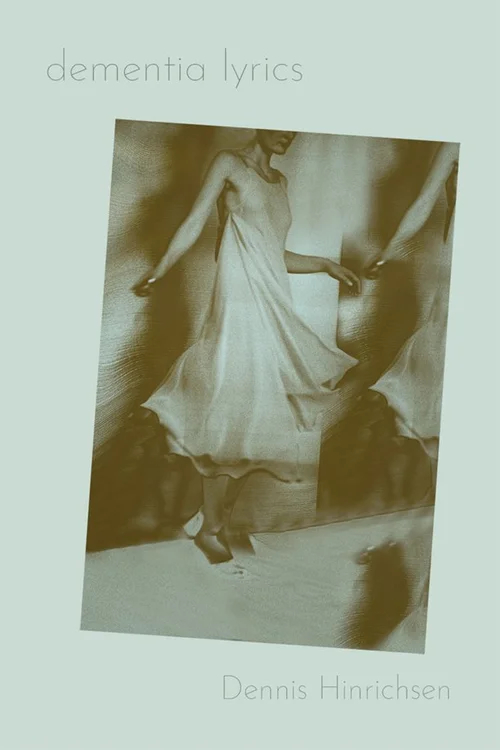
Dennis Hinrichsen, Dementia Lyrics,
Green Linden Press, 2026,
ISBN: 978-1-961834-11-8, 100pp, $20.00.
Especially for a certain demographic (okay, mine), Dennis Hinrichsen’s theme about dementia is compelling. Dedicated to two friends who died at the age of 73 (my age), as a result of their dementia, it’s the poet’s overriding preoccupation, but homelessness and alienation are not far behind. This is Hinrichsen’s vision of The Modern American Wasteland. He introduces the reality in the first poem, “I Had a River Once. Two Friends. This Is the City of Dementia”:
a friend of mine from
the city
of Dementia can forget
a thing
just by looking at it (charred
lemon
meringue) and then letting
time
pass or a stanza pass—time’s
the fire for him—
my presence is a flotilla
of
clouds—a clot in open sky—
he remembers
my name—so far—it signals
comfort—
lyrical nonsense
energy—
I am here to play
with pencils—
he was a cartoonist once—
but he’s tired—refuses
this—refuses his pills—waves me way
This is heartbreaking, of course, the poet’s helplessness, his friend’s deterioration. And then later in the poem, the second friend –
the way second friend burns
you’d
think he was aura-ed
in
methanol
but it’s just his cerebellum
clear-flame shutting down—
the clog
is consciousness—
that’s where the suffering is—
The next dementia lyric is called “[shotgun] [Self-portrait as a Painting by William S. Burroughs with Jr. Walker & The All Stars].” He continues to metaphorically depict the tragic condition, to show it in almost allegorical terms. Note that Hinrichsen has always had a penchant for inserting a certain “soundtrack” into the abstract dramas he’s outlining, sort of like Jean Luc Godard’s Sympathy for the Devil. Indeed, the junk car parts and spraypaint graffiti are reminiscent of the apocalyptic vision of Godard’s One Plus One.
graffiti-esque the brain these days—
each moment a train car wreckage of
Krylon and illegibility filled
with car parts—often chassis
and moonroofs—front
and back bumpers—
I live in a car town you see—
they line up like pretty candy
a mile from here—boutique chocolates
of raw American steel (mostly)
and so much horsepower
even R. E. Olds would buckle
to his knees—
Channeling Walt Whitman, as he does throughout this volume (see “Synapse,” involving a patient in a hospital who once asked him to kill her), Hinrichsen continues to draw the picture in “He was a Boy. He Had a Boat. This Is the City of Niagara Falls.”
I sing the body electric I sing
the future of
death I wish I had stock
in it
it happens so quickly
ion channels breaking
down
mitochondria lost sucked
into
the Lewy bodies those spheres
of
protein clogging the neurons
conclusion :: cellular death ::
(friend cannot reason now)
Poems called “Dementia Lyric with Miles Davis and a Gamelan,” “Dementia Lyric with W.S. Merwin and a Cobra,” “Dementia Lyric with Issa and a Falling Bird” spell it out even further. And then there’s “Dementia Lyric :: unbeknownst,” subtitled a short film on engram theory called the forgetting. The mystery of dementia baffles us all, but the poet fleshes out its implications and manifestations. “Dementia Comes in Many Forms. Alzheimer’s Is Just One,” a New York Times article tells us. Hinrichsen writes about ataxia, a neurological condition which affects muscle control, into the weeds, medically. And engram theory? An “engram” is a unit of cognitive information in a physical substance, the theory having to do with how memory is stored. Unbeknownst is the section title here that includes these poems, and there is so much that isn’t known, that he can only show and make guesses about.
The Day Zero Sequence section, one of four the collection is divided into, begins:
Cannot speak. Cradles smartphone. Trembling hand. Letter by letter, stabs
last good thing he will ever say to me. No. 2 pencil. Eraser tip.
Later in this section, in “Pedal Steel Death Song”:
last words swallowed last vapors
where does language go when body fails
Homeless people appear regularly in these poems, at intersections, asking for things. It’s part of the zeitgeist, A Clockwork Orange vibe. In “[cinéma vérité] [with Automatic Window]” it’s precisely seven dollars and forty cents the man requests. In “Dementia Lyric with Miles Davis and a Gamelan,” “on cue / another of the city’s extras approaches to ask / for spare work.” In “Postcard Utopia,” a panhandler begs for money. In “[lyricism] [Musique Concrète]” two homeless men appear. Later it’s a homeless man pushing a grocery cart in a “city of genocide” – “gunshot city,” “day zero city” – in This Is the City of His Dying, the fourth major section of Dementia Lyrics.
Water – aquifer – river – rain – is a potent image throughout Dementia Lyrics. Life-giving but also polluted, Hinrichsen metaphorically associates it with the brain. As he writes in “Aqua Americana”:
I am dowsing now this is microdose my psilocybin
rush toward you from you Silurian Devonian
since brain too is aquifer
In a note, Hinrichsen informs the reader that Silurian Devonian is the groundwater reservoir beneath the Home Place where his family farmed in Iowa. An aquifer is a body of permeable rock which contains and transmits groundwater – it is lifegiving, life-sustaining. The brain is the pool of memory, consciousness. It can also be polluted like any water source. “I Had a River Once…” begins:
in the vocabulary of river this is foam—
in neuron
clogging protein (river cannot stream
with it)
(friend cannot burn new engrams)
Later in the poem he writes:
someone has inserted Death
in the river
and it’s floating downstream—
“Aquifer Manifesto” follows “Aqua Americana” – which ends “A drink of water (a poem) is just a sequence of drops that have fallen / from the sky. Unending. As closure is. As ambient is.” “Aquifer Manifesto” is essentially a poem in praise of rain, aquifer. The final poem, “re.ac.tor.se.quence,” which appears on the page as white lettering on a black background spells the metaphor out:
death of fresh
water :: the body
aquifer :: I can feel it
as self-
shining
dries :: handbacks leathered ::
spotted :: the cerebellar
pinching
at memory already
beginning ::
neural nets
tearing :: knots
(that
kiss in the dark)
coming
undone
Interestingly, Hinrichsen likens the state of dementia to Zen Buddhist consciousness, being forever in the now, which is not a completely tragic idea at all, is it?. In both “I Had a River Once…” and “Atrophic” he makes this connection, and again in “Dementia Lyric with Miles Davis and a Gamelan,” when he contemplates his “friend besieged / by dementia”:
morning coffee lost to him—his Zen moment
on an endless loop
so he is almost Miles Davis some days—
a bitch’s brew
of redundancy cutting him to pieces—
Dementia Lyrics is a brave attempt to understand that umbrella term, “dementia”, when memory, reasoning, thinking decline, to express in lyrical terms the effects and consequences. Dennis Hinrichsen is nothing if not a uniquely innovative poet, language in his hands like hot steel in the hands of Hephaestus, deity of fire and metal-working.
Charle Rammelkamp
To order this book click here
Charles Rammelkamp is Prose Editor for BrickHouse Books. His latest collection is The Tao According to Calvin Coolidge, Kelsay Books.
It's not easy getting a book or pamphlet accepted for review these days. So in addition to the regular review section, the One Poem Review feature will allow more poets' to reach a wider audience - one poem featured from a new book/pamphlet along with a cover JPG and a link to the publisher's website. Contact the editor if you have released a book/pamphlet in the last twelve months or expect to have one published. Details here
Reviewed in this issue


 Share
Share Print
Print