

Menna Elfyn, Parch, Bloodaxe, 2025,
ISBN 978-1-78037-754-4, 128pp, £12.99.
The publication of Parch is a watershed moment for Elfyn, all of whose previously published poetry has been written in Welsh, much of it published in dual Welsh-English translation editions. This collection includes not only poetry written in English, but poems of hers written in Welsh and translated either by herself, or other poets, notably Emma Baines, Gillian Clarke and (remarkably) R. S. Thomas, that famous English Cymru-phile. Elfyn explains in her preface that (not least thanks to advocates like herself) Welsh now being accepted as the official language of Wales, she feels she can write poetry in English.
The title of the book illustrates the richness of Welsh, meaning both ‘respect’ and the title for a spiritual leader (the equivalent of ‘Reverend’). Elfyn thinks the word in that first, conceptual meaning, is perhaps ‘one of the most salient and urgent words of our time’. This is illustrated in many of the poems, which invite respect for a huge range of subjects, from figures in Welsh history and mythology, to contemporary women in vulnerable circumstances.
It’s unsurprising, given Elfyn is the child of a Manse, to find a lot of spiritual poetry here. This is always a difficult word to unpack as it means so much more than doctrinal dogma or even faith (though these do appear); to quote Dylan Thomas in a poem in his memory: ‘Parch. It’s a force for good; / for some, the desire to reach God.’
But there is also spirituality in the poems honouring the need to place flowers at a grave, or broader occasions that focus on the non-material aspects of life which nourish the soul, whether it is ‘the loneliest places’ from which she ‘draw[s] breath’, or a sense of the sea urchin she finds being ‘blessed by the sea’s mercy.’ The spiritual is an inherent part of her vocabulary.
Evaluating poetry in translation without being conversant in the original language is a balancing act; how do you critique the new form that is the translated poem, without comparing it to the original? On occasions I found myself wishing for clearer notes or signposting about the Welsh words included (for example, cyngharedd, which appears in one poem but is not glossed till its re-appearance some pages later on). Some English phrases are also unfamiliar to me – presumably ‘stop tap’ (which resisted my attempts to look it up by diverting me into the world of plumbing) presumably means the hour at which pubs stop serving alcohol?
I especially enjoyed the poems written originally in English, where the potent ‘mouthfeel’ of word shifts (milestones/millstones; needed/heeded; sterling/a-stirring; look out/lock out’) conveyed a lush musicality and depth of meaning. ‘Gauze in Gaza’ is especially striking. In some of the translated poems there are interesting uses of homophones – ‘berthing’ where I was expecting ‘birthing’ (‘Given to Legend’) and ‘wears’ for ‘wares’ (‘End notes’).
As suggested above, Elfyn’s lens is not purely pointed towards Wales – and there is diversity of tone as well as content with humorous touches (‘Water’) which adds leaven to the more sombre subjects. I’ll close with lines from the long sequence ‘Stones’;
A poem like people
wants to be on the move
un-walled, free songlines.
Perhaps writing in English now, as well as continuing to write in Welsh, has freed up something for Elfyn; it’s certainly provided a rich feast for her reader.
Hannah Stone
To order this book click here
Hannah Stone is the author of Lodestone (Stairwell Books, 2016), Missing Miles (Indigo Dreams Publishing, 2017), Swn y Morloi (Maytree Press, 2019) and several collaborations, including Fit to Bust with Pamela Scobie (Runcible Spoon, 2020). She convenes the poets/composers forum for Leeds Leider, curates Nowt but Verse for Leeds Library, is poet theologian in Virtual Residence for Leeds Church Institute and editor of the literary journal Dream Catcher. Contact her on hannahstone14@hotmail.com for readings, workshops or book purchases.
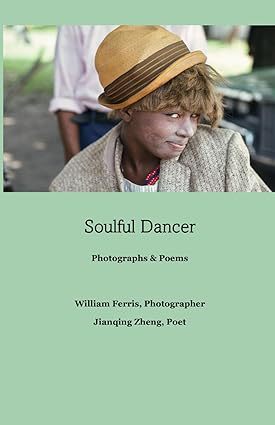
William Ferris and Jianqing Zheng,
Soulful Dancer: Photographs and Poems,
Blue Horse Press, 2025,
ISBN: 979-8-218-65326-2, $34.50, 84pp.
Like his previous collection, Still Motion, a collaboration with the photographer Leo Touchet, ekphrastic poems responding to Touchet’s photographs of Death Valley dunes and jazz spectacles in New Orleans, Jianqing Zheng’s latest project, Soulful Dancer, is a collaboration with another photographer, William Ferris, whose photographs capture the beauty and mystery of the Mississippi Delta region. Soulful Dancer is divided into four sections, Homeplace, Community, On the Road, and Music. Zheng’s poems and haibun are in response to the photographs.
Fittingly, the very first poem is called “Mississippi Morning,” as though you were just waking up to the fecundity of the Delta region, all that sound and sight and smell slapping your senses. The color photograph is of a horse pasture in Warren County, Mississippi. Capturing the quiet beauty of the solitude, Zheng writes:
The dewdrops drip
like strands of dreads
from pine trees,
the sun rises
like a cowboy with a bandanna
swinging a lasso of light…
He goes on to describe the bucolic setting depicted in Ferris’s photograph – the fog, the bordering fence, the cardinals singing – to vivify the tranquility in that quiet moment of awakening.
The haibun that follows, “A View from Fisher Ferry Road,” after another peaceful pasture photograph, three pine trees in the misty sunlight (“Three pine trees look like ballerinas on tiptoes about to pirouette for a premiere show.”), likewise captures the serenity of the scene the photograph displays.
Interestingly, Zheng occasionally identifies with the photographer in his verses. In “Reflections on the Lake,” after a photograph of Wes Carter Lake, which is likewise located in Warren County, Zheng writes:
Snapping shots by the lake,
I catch a moment of reflection
on the lake of the mind.
It’s a photograph of trees, clouds and sky in a shimmering reflection on the lake water, the reflection of a tree trunk wavering in the gentle ripple of water. Zheng identifies with Ferris here as the person actually operating the camera. We see this, too, in “Summertime,” a poem based on a photograph of a watermelon vendor and his son displaying a large half melon, its pink meat vivid against the white truck the two are standing in front of, smiling at the photographer. Smiling back, I grab the shot / of this sweet moment.
The Community section that follows is mostly composed of portraits of different African-American people posing for the camera – a woman dressed for church, people standing by their handmade quilts, the “Soulful Dancer” herself, for whom the collection is named. Zheng accompanies this photograph with a haibun describing the woman, her sparkling eyes, her dance movements and the clapping and whistling they elicit from the onlookers. “Delta Heat” is after a photograph of a man astride a small white pony.
He looks smug and heavy
like a policeman on patrol and
his face glitters with sweat.
My favorite section is probably the third, On the Road. Here we have poems and haibun that respond to images of things, without human beings – the lonesome stretch of flat highway, parched brown grass by side of the road under a relentless sunny sky relieved by just a smattering of clouds, a lone truck up ahead; a shadowy modest church interior, pews lighted only by the sun streaming in from a smudged window. “On one end of a pew lies a white paddle fan,” Zheng writes in “After Church”, “like a kitten curling up to reclaim the good of silence which sprawls like kudzu in the presence of Holiness.” Zheng deftly concludes the haibun:
waking dream
the in and out
of a butterfly
A pair of church windows from the outside and a pair of empty chairs on a porch also inspire the poet’s imagination, the latter a poem called “Long Time No See,” an imagined reunion between two old friends, Mark and Tiger, who fished together in the Sunflower River as schoolkids before going their separate ways. Mark became a musician in Chicago. Tiger joined the navy.
Now they return, recollecting
their old days—gold grains sieved
from the sunset over their dreamland.
The final section of Soulful Dancer deals with a longtime love of Zheng’s, and a key component of the region: music, specifically the Delta Blues. “Delta Blues,” “Preaching” — for you certainly can’t have religion and prayer in the deep South without soulful music — “Soul Deep” and “Live Show” all highlight the Delta music. “Couple,” with its accompanying photograph of an aging man and woman, highlights the connection between love and music:
Love is molecules
joining atoms
for chemical reactions,
it’s plain life
like they hold hands
till old age,
it’s oneness
as staunch as their roots
gnarling together
like a Delta blues song
dedicated to
wind and rain,
sun and moon,
and the flatland
underfoot.
And what would a Jianqing Zheng poetry collection about the music of the South be without a reference to the legendary B.B. King and his guitar Lucille? Just as King’s included in Still Motion, so he appears in the penultimate poem in Soulful Dancer, “Call and Response,” alongside William Ferris’s photograph of King taken at the Lucifer Club in Boston in 1976.
Soulful Dancer is a satisfying tour of the geography, the ethos and aesthetic of the Mississippi Delta region, captured in both words and images. I can’t wait for Zheng’s next collaboration.
Charles Rammelkamp
To order this book click here
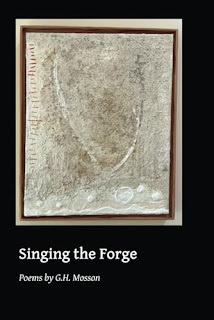
G.H. Mosson, Singing the Forge,
David Robert Books, 2025,
ISBN: 978-1625494801, $18.25, 90pp.
Gregg Mosson begins his collection at the beginning, as it were. In “First Steps” he writes:
I’ve traveled beyond
the petri dish of school
to start
with hand-me-down
maps
in the land of adults.
Singing the Forge is a work of self-reflection, a coming-to-terms with the world. One thinks of Whitman’s “Out of the Cradle Endlessly Rocking,” its theme of suffering and art. I’m also reminded of David Bowie’s observation: “Aging is an extraordinary process whereby you become the person you always should have been.” This may be Mosson’s ultimate point. Becoming.
Loosely organized around the concept of song, the book is divided into three parts, Departure Songs, Melodies from the Mirror, and Hearing My Own Hum. The metaphor necessarily shines a spotlight on “voice.” Again, one thinks of Whitman and his Song of Myself. “Forge”, after all, implies heating and hammering, beating something – a life – into shape, the way one forges a friendship, say, the way one creates beauty.
“Departure” is another loaded concept. Life is exile. There’s nostalgia implicit in the leaving behind. We see that in poems like “Grandmother in Silhouette” (“the spicy backstory of her laughter”) and “Clean Slate” and “Unfound,” memories from youth in the Pacific Northwest. “Tidal Song” distills the experience of the tug of the past and the forging of a future:
Maybe the jellyfish also sensed – as the tide
kept washing it up, pulling
it back – maybe we are all estranged
in this: unwilling
to die, unwilling to yield.
Indeed, as Mosson writes in the final poem of Singing the Forge, “Summer Voyage at Thirty-Eight”:
There lurks a vast thing from which I am exiled.
I sense it as I pick up children’s toys
From the front steps, as dusk falls…
Life as exile is a philosophical concept dating as far back as Plato. “The child is father to the man,” as Wordsworth wrote in “My Heart Leaps Up.”
Part Two, Melodies from the Mirror, implies a kind of navel-gazing. But most of the poems in this part focus on characters other than the poet. The clue may be in the very first three-line poem, “Gloria’s Dive”:
Dressed in what she knows,
she stiffens in a red chair,
sounds down her blurred life.
The blurred life, indeed; we are exiles in time. As Socrates famously said, “The unexamined life is not worth living.” But where does one even begin? “Spicing Up the Afternoon” focuses on two characters named Sue and Bert in Cambridge, Massachusetts, two people who once were intimate but who’ve become estranged over two decades. Sue is a widow with two children. Bert teaches in high school. There’s apparently no chemistry between them any more. “Winging It” – another ambiguous title, implying the improvisations of life – is about an airline flight attendant, a day in the life. “Ghost Villa” is in the voice of a retired physician in Florida. “Second Honeymoon in Montauk” (Whitman’s stomping grounds!) is about a couple named Daniel and Sarah, This, too, seems to be a reunion of sorts. They’d met in Greenwich Village, and they’re still feeling each other out. And now they find themselves in Montauk, at the tip of Long Island.
Above the dunes, the motel
in Montauk looms: a cliff of shadows
with cave-fires in the wilderness.
Mosson also draws inspiration from paintings – ekphrastic poetry – in this section. Five of the poems flesh out in words several images from Whistler’s Sketchbook – The Mustard Merchant, The Miser, a scene along the Thames in London (“See Me With”) among them. “Death of a Harlequin” is after Picasso’s Expressionist painting which hangs in the National Gallery of Art in Washington. “Warrior with Shield” is after Henry Moore’s bronze sculpture which is likewise on display at the National Gallery of Art.
In addition, the section includes three translations of short poems by the German writer, Johann Wolfgang von Goethe – “Nearness of the Beloved,” “Wanderer’s Night Song” and “Another Wanderer’s Night Song,” In a note, Mosson tells us that the translations are a collaboration with Jim D. Nicholson. Their romantic tone informs this “look in the mirror.” “Wanderer’s Night Song” reads:
You – that from the heavens are –
All the hurt and sorrows still,
So the doubly outcasts are
Doubly with life’s waters filled;
O, I tire from being driven!
What to make of joy and hurt?
Dearest peace,
Come, come into my heart!
Whoa, Wolfgang! Written by the same man who gave us The Sorrows of Your Werther, from the early Sturm und Drang phase of Romanticism, the sentiment may seem overwrought.
Part Three, Hearing My Own Hum, brings us back to the poet in his studio apartment in Charles Village, Baltimore, figuring himself out. “Pandora’s Moon,” which starts the section, even has a sort of Goethe-like vibe. The poem ends:
Dearest Other
if you peeked
in with a telescope
you’d find me ant-sized
at work at my desk
attempting to forge
these Pandoras
into some bright metaphor
where crafted surfaces
reflect you,
mute mirror, the Moon.
“Dirge,” “Impossible Sunrise,” “Winter Recess,” “Rush Hour,” “Flight Over Baltimore,” “October Deluge,” “Window on Early March,” “Night Studies,” “Treaty at Thirty-One”: in all of these poems we see and attend the poet as he labors away, hermit-like, in his apartment overlooking busy Baltimore streets. “Winter Camping in Baja California” recalls an episode on the beach, entering a vacant house, “as if some family had left mid-sentence.” Technically, it’s breaking and entering, and the protagonist of the poem does pilfer a blanket. But the sweetness of the poem is in the final four lines, which link a life across time to the new one he inhabits, and for a moment it seems as though the exile is over, even if this is only an illusion:
From receding years, I’ve made this braid
of lyric and kept that blanket
on my son’s bed, for his winter warmth,
with a baked-in sun his Dad has met.
In Singing the Forge, G.H. Mosson, to invoke to
image of Walt Whitman one more time, does “sing the body electric.” Or maybe it’s the spirit, the life.
To order this book click here
Charles Rammelkamp is Prose Editor for BrickHouse Books. His latest collection is The Tao According to Calvin Coolidge, Kelsay Books.
It's not easy getting a book or pamphlet accepted for review these days. So in addition to the regular review section, the One Poem Review feature will allow more poets' to reach a wider audience - one poem featured from a new book/pamphlet along with a cover JPG and a link to the publisher's website. Contact the editor if you have released a book/pamphlet in the last twelve months or expect to have one published. Details here
Reviewed in this issue


 Share
Share Print
Print