
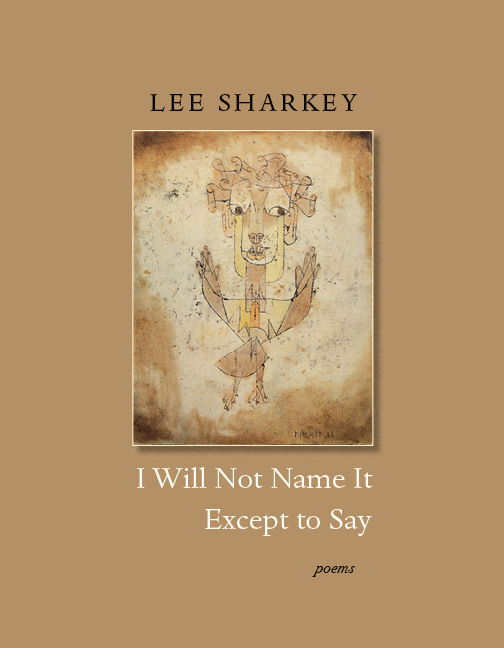
Lee Sharkey, I Will Not Name It Except to Say, Tupelo Press, 2021. ISBN: 978-1946482495. 90pp. $18.95.
The very title of Lee Sharkey’s posthumously published collection suggests the ineffability of her themes, subjects too great to be expressed in words, and yet, as she writes in the eponymous poem,
"We read, we write, we do language"
That is how, a mentor tells me, civilizations heal
Sharkey’s poetry is all about healing, and therefore all about grief and suffering, too. She deals with a range of subjects, from ekphrastic poems about German Expressionist painters and their work to Jewish themes, both religious/spiritual and historical, to the very, very personal.
Angst was the predominant response of the Expressionist
artists to their reality. The artists Sharkey singles out are almost exclusively the Germans from the pre-World War One and Weimar eras, Kandinsky and Klee, August Macke, George Grocz, Franz Marc
and Käthe Kollwitz.
“Whoever you are you are someone saying farewell,” she writes
in “Farewell,” after Macke, and in “Dead Man in the Mud,” an ekphrastic poem on Otto Dix’s famous etching from his portfolio, Der Krieg, depicting the horrible realities he experienced
during his three years as a soldier (later vilified by the Nazis as “degenerative art”), Sharkey writes:
“The war was a horrible thing”, Dix wrote, “I certainly did not want to miss it”
His soldier a century dead, mired, with resin for a mordant
Grief lives in the ground, I learned at Babi Yar. It nourishes. Cannot be extinguished
Joy rests in its arms, embraced for millennia, cradled through the night
Something is mapping the earth. Its wings have roots that have crawled through rock Its soil holds seeds that are waiting to surface
Sharkey devotes three poems to Kollwitz, who worked with painting and woodcuts, lithography and sculpture to depict the effects of poverty and war on the working class. In “After a Sketch by Käthe Kollwitz,” Sharkey describes a woman with “eyes shut so she can see / her lost-and-ever-with-her,” an image that echoes the ineffability of the book title.
Sharkey also devotes a whole section – a dozen poems – to Samuel Bak, a Jewish refugee who spent his early years in the Vilna ghetto. In “Still Life” she writes, “Never enough destruction makes for never enough blessing,” and in “Civilization,” “You have lost everything but not what makes you human. I don’t mean your coat and tie.” In this set of poems Sharkey uses imagery from Bak’s paintings to underscore the issues of humanity the artwork evinces.
A peace activist, Sharkey, who died in October of 2020 from cancer, was always keenly aware of social injustice. This is evident not only in the poems and people already discussed but elsewhere in this collection as well. For instance, “What the News Won’t Tell” is about the heroic Chechen librarians, notably Sacita Israileva, head librarian at the Grozny State Library, who, threatened with destruction by “the general of the occupying army,” nevertheless kept the library operating, saved the books.
“To Look Out Is to See” is a poem about the Feminist Movement painter May Stevens’ portrait of Rosa Luxemburg, the Polish Marxist philosopher and economist who was murdered in 1919 by German paramilitary members, shot in the head as she was getting into a car that was transporting her to prison for her revolutionary ideas. The poem is a detailed description sprinkled with text from May Stevens’ journals and Rosa Luxemburg’s prison letters to her friend.
My notion of history, simply put, is that I am a part of history.
Above Rosa’s coffin, Stevens paints: Ich bin, ich war, ich werde sein. (I am, I was, I will be.)
In the poem “Thief,” Sharkey succinctly offers:
The tyrant, the buffoon, the egomaniac.
The quantum state where the despot is all three.
Sound like anybody you know?
Sharkey also writes some deeply personal poems from a Jewish perspective, mourning the loss of her father (“Fedora,” “The Lapse Between One Sock and Another,” “In a season of Tyrants, Old Angers Rise”), her mother (“Like You”), her cousin Arlene (“Thistle”: “Soon, I’ll be the only keeper of the memories that made a family. / I don’t trust myself with that much treasure”). In “Tashlich,” a poem alluding to the Jewish custom at Rosh Hashanah to throw bread crumbs on the water to symbolically rid oneself of one’s failings, she sums up this whole impulse. “Where I came from / whoever heard of an afterlife.”
But the most moving of these personal poems are the ones that refer to her husband, Al Bersbach, who was succumbing to Alzheimer’s in their final years together. Al would die two months after Lee, in December of 2020. The final two poems, “Burn” and “Grief” allude to her husband. “If every day I worship at the altar of my grief, who is it I am true to / Father, mother, now another,” she writes in “Grief,” and later, in the same poem, “Father, mother, and now another, grief is my sister and my brother.”
As she writes in another Jewish poem about Job, “Therefore I Will Be Quiet, Comforted That I Am Dust”: “What Job wants is a word with the Unnamable / to ask the old question: What is the purpose of suffering? What did I do that I should suffer so?”
The poem, “Letter to Al,” which in 2017 won the prestigious Ballymaloe International Poetry Prize in Dublin, is especially heartbreaking.
What’s the game plan? Take each day as it metastasizes,
Lord, your humble servant, Shekhinah of the midnight hour.
In whose hands we place ourselves in medicated dreaming,
the voices calling each other’s names: Wake! Emergency!
I fumbling to you. You fumbling to me. What can I do? Just stay
with me. Till the end of shadows. Till the end of end.
Amen.
Charles Rammelkamp
To order this book click here
Charles Rammelkamp is Prose Editor for BrickHouse Books in Baltimore, where he lives, and edits The Potomac, an online literary journal. http://thepotomacjournal.com. His photographs, poetry and fiction have appeared in many literary journals. His latest book is a collection of poems called Mata Hari: Eye of the Day (Apprentice House, Loyola University), and another poetry collection, American Zeitgeist, is forthcoming from Apprentice House.
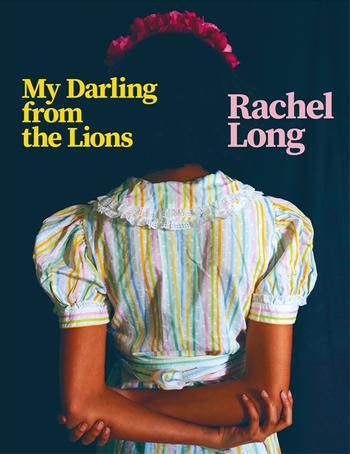
Rachel long, My Darling from the Lions, Picador. ISBN 9781529045161 96pp. £8.99.
This is Rachel Long’s first collection but she is already a significant figure in the poetry landscape as the founder of Octavia Poetry Collective for Womxn of Colour. The title of this volume is a quotation from Psalm 35 but there is nothing in the text to connect with this apart from the several references to established religion in the autobiographical parts of some poems.
Negative Capability is alive and well in Rachel Long. She has a very clear, sharp and distinctive voice deploying many frank and personal expressions that are vivid and arresting, but her diction, phrasing, line arrangement and playfulness provide a counterweight to this, producing much ambiguity and mystery along the way. Perhaps the most extreme example is ‘Helena’, which drops the reader uncontextualised into a torrid mixture of events and dialogue that demands and discourages re-reading in equal measure. It’s certificate 18 minimum and provides a reading experience that you won’t forget, no matter how much you may want to.
An only slightly less off-putting piece, ‘The Clean’, is a remarkable achievement, blending tactile description and enigmatic reflection to produce a poem that rewards almost endless re-reading. The first stanza strings together many phrases carved from modern consciousness but steeped in ambiguity:
you’d die
without this,
clutching your ribs
in the dark,
one street from home,
footsteps gathering
This illustrates perfectly Long’s ability to conjure up quick drama in a metaphor, keeping the intrigue simmering while disparate phrases swirl up into raw, urgent excitement. In the poem’s second and final stanza the contemplative element is combined with the humorous warmth that is never far away in this book, no matter how dark or heavy the subject matter may be:
I know a place where
the sad can’t go,
where it’ll never have
the right footwear.
The poem finishes with a sequence of short sentences hinting at a multitude of interpretative levels, from the inspiring moral to the miserably bathetic. This makes it a very modern poem, and Long’s work in general appears to me to fit into a modern aesthetic where clarity is the only sin. This is probably only a problem for me as an aged critic schooled in poetic expression that helps rather than splinters the reader’s awareness and understanding. I do love the ambiguity, and the flexibility of Long’s imagery is a power, not a weakness. In the end, however, there is not much in this book that I would be keen to read aloud for an audience or share with a loved one.
The whole book is in free verse, which is not a fault, of course, but it does make me wonder whether this is a choice made in freedom or limitation, especially as rhymes, when they occur, appear to be inadvertent as well as inevitably intrusive.
There is a lot of wit along the way, delivered in sweet snippets of warmth, as in ‘Hotel Art, Barcelona’:
Contorting myself three ways in the toilet mirror,
I decide I won’t look like this forever.
I don’t even look like this now.
And the opening couplet of ‘Bloodlines’ sets you up for a very different story to the one that is actually delivered. I’m not going to spoil it for you, but it is a delightful fusion of funny and clever; do check it out.
The book is divided into three thematic sections but these are not completely separate in their subject matter and the actual techniques are wide ranging throughout. Long is handling big themes, including race, sex and class, but she is a young poet so, as you might expect, childhood and family feature heavily and most movingly. Thus, for me at least, a small-scale piece called ‘Portent’ represents most of her current strengths in one conflicted space. “I feel middle class when I’m in love” is the winning opening line to a stanza which pictures middle class love life as “all poached eggs on bird-seed bread, / staying up all night on Zoopla.” Stanza two twists the scene into the opposite of romantic enchantment, via two lines of documentary textbook-speak, but the hinge swings on a further rusty creak of humour: “I think about this while I’m having a fag-I’m-quitting.” Surrounding these details are the bipolar romantic and brutal pictures and perhapses of love. The strength of this poem is shown in the way it would take a whole page of analysis to summarise and set up the three different pairs of short lines that make it so effective.
This book’s many pop-culture references include celebrity names and famous brands, some of which appear either gratuitous or acting as uncrafted shorthand. It’s not just the ingrained and understandable “hoover”; both “prosecco” and “marigold” are mentioned without their trade-name capitals, as if they were standard generic vocabulary.
Long’s poems are full of energy and, despite their sometimes grim subject matter, the overwhelming feeling that comes through in this book is positive, life-affirming, warm and funny. She can make you cry and laugh in the same poem, sometimes with the same line, as here in ‘Danielle’s Dad’:
Danielle is not very clever.
She thinks the Woolwich Ferry is the Titanic.
Look! She said as we drove around the roundabout,
The Titanic!
Even Mum pretended not to laugh.
Rachel Long is not a great poet yet. She has the voice and some of the craft, but naturally lacks the wisdom and perspective that enable a writer to distil thought and emotion into an essence of expression. She has already made an impact in the world of modern verse writing. That is achievement enough for now. I am happy to have her first book in my collection, and I look forward to watching her undoubted talent mature in future publications.
Ric Cheyney
To order this book click here
Ric Cheyney is an agrarian misanthrope, writer, critic, songsmith and woodland gardener. He lives in north west Wales, UK. His collection, In Praise Of Nahum Tate, can be ordered through your usual bookseller. See his website woodminster.net for more details.
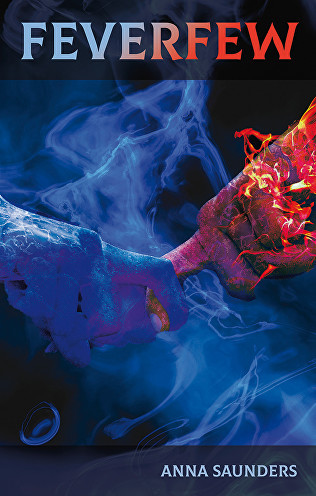
Anna Saunders, Feverfew,
Indigo Dreams Publishing, 2021.
ISBN 978-1-912876-26-6. 52pp. £9.50.
“How to hunt in silken plumage/tooled up with talons and hooks”, - the first two, mesmerising lines of Anna Saunders’ FeverFew. The living of life is the battleground, here, apparent in this opening poem, ‘What I Learnt From The Owl’. With their big declaration, the sound of these lines gives sharp warning for what’s to come. This is a poet who has learned to fight, and is able to give us clear imagery of exactly how the experience has taken its toll. Anna Saunders reveals intimate moments of her own life, transmitted via her considered poetry. She details the journey made, as well as where she’s headed, as a result. Her spiritual pilgrimage is tracked, through these poems.
Darkness and light, suffering and healing, the pain of remembering and forgetting: these aspects are present throughout this collection. They’re framed via references from classical mythology. For example, via the well-known story of Icarus. We’re reminded, in ‘Now the Earth is an Embering Coal’ that “Icarus didn’t listen either”. This opening line prepares us for a warning, abundantly brimming with anguish, loss and despair, in the last two lines: ’as you plunge like a falling star/deep into the orphaned dark’. So, despite the lessons, regardless of the fact we are all signposted that we might be sorry for our actions, Saunder’s knows that it’s something we have to work out for ourselves, doing so the hard way. Clearly, she’s had to learn that, too.
Our own minds, as that which keeps us captive, or releases us, is the theme of ‘Sisyphus in the Psychiatrist’s Chair’. As we hear that “It is a monstrous weight that pestles him down to a powder”, what follows is the crux: ‘yet Sisypus won’t let go of the rock’. There is an epigraph from Camus’ ‘The Myth of Sisyphus’, above this poem, reading The struggle alone to the heights is enough to fill a man’s heart. In a brilliant turn, Saunder’s puts a further spin on this idea, with the line “But if Sisyphus lets go, his palms will hold only air”.
Prometheus is next up. In “Two Seasons With Prometheus”. The dual nature of fire – that source which burns and warms, is put into the poem. The line, ‘with time, my gouged heart healed’ uses juxtaposition, to powerful effect. This is a perfect way to sum up love, as an experience which softens us, but can leave us hardened, in a way we didn’t realise we could be.
Towards the end of the collection, the wonderful “Is This the ebb, or Flow”, works to further focus a key theme of the entire collection: being alive is tough. Human consciousness is at times a curse, and at other times blessing. But Of course, it takes a poet – and one of consummate skill such as Saunders – to point out that reality is much more complex and nuanced than that. The line ‘New buds on the magnolias breaking through’ again uses a tension of opposites to great effect, with the small sounding syllables of the first two words sounding out that small marvel. There can’t be growth without change, is the point; nor can that change always be understood, immediately.
The final poem, “Emergency Call” also acknowledges how hard being alive can be. Voice is used wonderfully to connect poet and reader, by use of direct questions. Some of the final lines read ‘Does God seem out of reach?’, ‘Does your head throb’ and ‘Where else does it hurt?’. Saunders knows not to answer these questions, and that the burden and beauty of being human means we must find answers along the way. And that’s what this fantastic collection helps us so, asking big questions. But it also rejuvenates faith that eventually life will provide answers – though first we must endure the tumultuousness task of searching – a painful, but essential process of self-discovery.
Benjamin Francis Cassidy
To order this book click here
Benjamin Francis Cassidy was born in Blackpool, in 1982. He lives in Manchester with his cat, Lucy. He gained his Degree from Manchester Metropolitan University in 2018, in English and Creative Writing. Ben’s poems appear in anthologies by Fly on the Wall Press, Yaffle Press and Local Gems Poetry Press. He’s also had numerous reviews of poetry pamphlets and collections published, by organisations such as Drawn to the Light. Mad Hatter Reviews, Sabotage Reviews and The Lake, amongst others.
It's not easy getting a book or pamphlet accepted for review these days. So in addition to the regular review section, the One Poem Review feature will allow more poets' to reach a wider audience - one poem featured from a new book/pamphlet along with a cover JPG and a link to the publisher's website. Contact the editor if you have released a book/pamphlet in the last twelve months or expect to have one published. Details here
Reviewed in this issue
 Share
Share Print
Print