
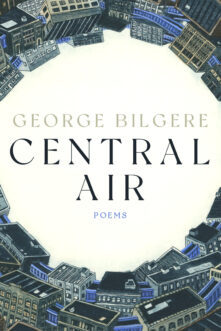
George Bilgere, Central Air,
University of Pittsburgh Press, 2022.
ISBN: 978-0-8229-6689-0. $18., 72pp
In the final poem, “Ripeness,” of his new collection, George Bilgere asks, sitting in his backyard at the end of summer, “How many bad roads
and back roads have I travelled
to be here tonight? How many
wrong turns and lucky breaks
did it take to sit me down
on this lawn chair on the twilight
rim of the world?
True, there’s an ominous hawk, “hulking and sullen,” who has settled in the neighborhood, a deathdealer “brooding somewhere / on the tree line,” so his garden is not exactly Eden, but still, there’s a deep sense of well-being,
streaming down to the west
above the laughter of my boys,
my wife singing.
Central Air is full of melancholy and the awareness of time’s wingèd chariot hurrying near, but there are also these moments when the poet can appreciate the here and now. In the poem “Reichstag,” set in Berlin, Bilgere skillfully contrasts the weight of History bearing down on mankind with the simple pleasures a boy can take from the moment before him.
My little boy and I are standing
in front of the Reichstag, which is burning
and coalescing with rich and complicated
history right there in front of us, but
he doesn’t particularly care, in fact
he’s not even looking at the damn thing,
having focused all his attention instead
on a tiny, intricately tattooed
black and red beetle at his feet.
Bilgere’s poems involving his two young sons are among his most affecting and humorous, so often contrasting innocence and experience. “Extinctions,” whose very title hints at Death (“”Something became extinct today,” the poem starts and goes on: “something small and furred or feathered / took a last sweet breath and let it go.”), relates the Puff-the-Magic-Dragon moment when his four-year-old boy, over his breakfast cereal, disdains the Teletubbies for being too stupid, when his father offers to turn on the television; they’re for three-year-olds, after all; he’s way beyond that now. The father thinks: “You have come
to a wondrous place, full of joys
and sorrows, beauty and cruelty.
“And just like that,” the poem ends, when his son tells him, though not in so many words, that he is growing up,
the Teletubbies have drawn their last breath
in whatever burrow it is they inhabit.
“The Scar,” “Pill Bugs,” “Mr. Something,” “I Heard a Fly Buzz,” “The Barn” and “Lullaby” are others that involve father-son interactions. In “The Barn” his boy is sitting on his lap. He is just learning to read, his father encouraging him. His son “makes me proud / when he gets it right, but it’s when
he gets it wrong, when his voice thins
and falters before the inscrutable word,
that I love him unbearably, thinking back
to long division and the terrible fractions
But there are musings on age and death aplenty here, related with Bilgere’s wonderfully wry, self-effacing humor. “No Problem” begins:
I sit here aging at the street side café
giving off the sickly yellow smoke of decay
while people walk by pretending
not to notice
He orders an iced latte macchiato from the teenaged waitress, who “floats in the creamy cool oasis /of her youthful lustrousness.” In the argot of the young, the girl says to “the fast-decaying,
maybe starting to smell bad, just about to be
covered with flies old leathery carcass I’m becoming,
No problem.
Except that there is, actually,
a problem.
Time’s wingèd chariot is hurrying near, damn it! “Because I Could Not Stop for Death,” channeling Emily Dickinson, “My Last Poem About Breasts,” “Notes for a Blues Song” and others enlarge upon the theme of aging. “My Last Poem About Breasts,” indeed, which alludes to Jack Gilbert’s poem, “In Umbria,” takes place in a classroom, the youthful students expressing their distaste for the old “perv” who ogles a thirteen-year-old girl’s breasts. The poet/teacher suddenly sees himself through the students’ eyes, rightly or not.
Central Air also includes a number of visceral poems about his own childhood in Saint Louis, his parents’ marriage slowly coming apart as his father became an alcoholic. These, too, are seen through the lens of childhood, this time reversed. “Last Night,” whose title brings home how real the events are, as if so recent even though they’re now more than half a century in the rearview – “I am ten with my father / in a St. Louis hotel.” It’s the last time he sees his father alive. “The marriage has been / pronounced dead.” “Anna Karenina” is a poem about his mother losing herself in novels the way his father did in scotch. It opens with the heartbreaking lines of all offspring as we consider our dead:
My mother was long dead before
I was old enough to ask her
who she was.
Weary from her nursing job, “the insertion of suppositories / and the emptying of bedpans,”
She disappeared into French
winters, she walked down
London streets or sat quietly
with Anna in her parlor.
“Moxie” and “Garbage Disposal” also address the subject, the latter including the funny but serious observation about his parents in a photo from their honeymoon, “my father / doing his amazing impression / of a normal person.”
Bilgere puts a comic spin on all of these wretched scenes,
refusing to wallow in self-pity but nevertheless acknowledging their pain.
And so it is with the strange world in which we live. “Stolpersteine” is a poem set it Berlin about the little reminders – “stumbling blocks” – placed in the streets
commemorating where certain Nazi atrocities occurred, while “back home the language
is heating up
the elected leader is shouting to the crowds
send them back where they came from them
being Muslims and Hispanics and so forth
“Red Light, Blue Sky” is a poem
about a friend randomly getting killed in his car in a Cleveland street, a painter named David Wilder caught in the crossfire of kids in a gunfight while he waits for the traffic light to change.
Bizarre times indeed.
“For the Slip ‘N Slide,” also from the perspective of a kid
while his mother struggles, recalls his long-lost LA friend Brenda, when “a place / called Watts had yet to ignite,” “the two of us now
keep on journeying deeper and deeper
into a country growing stranger,
less recognizable, more lonely every day.
“Surveilled” takes place in the parking lot of a Walmart, the security cameras sweeping over customers, a standard feature of modern times, but the speaker nevertheless feeling self-conscious under their lenses. The poem ends:
Because sometimes I feel like there’s a
loneliness,
a new kind of loneliness in the world, that –
but here’s my car.
So it’s nice that every now and then, on a random night in one’s own backyard, you can appreciate your life, the “ripeness” of it, as his sons
chase each other on the grass
and from the kitchen window
I hear my wife singing along
with Björk on the radio, happy
because she loves the ruckus
the boys are raising, these animal boys
made of ourselves.
Charles Rammelkamp
To order this book click here
Charles Rammelkamp is Prose Editor for BrickHouse Books in Baltimore, where he lives, and edits The Potomac, an online literary journal. http://thepotomacjournal.com. His photographs, poetry and fiction have appeared in many literary journals. His latest book is a collection of poems called Mata Hari: Eye of the Day (Apprentice House, Loyola University), and another poetry collection, American Zeitgeist, is forthcoming from Apprentice House.
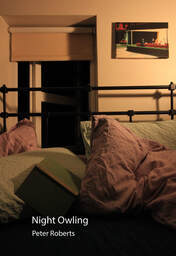
Peter Roberts, Night Owling,
Dempsey and Windle, 2022,
ISBN: 978-1-913329-70-9. 40pp. £8.00.
Peter Roberts chooses to ignore the received wisdom that the title poem should not be placed at the beginning of a collection. He is proved right in doing so for he delivers one of the most dynamic openings to a collection that I have come across.
‘Night Owling’ is a prose poem almost devoid of punctuation that imitates the drifting associative mental experience of insomnia, a condition which Roberts suffers from on a regular basis. The apparent formlessness disguises what is in fact a skilfully executed piece that has the wit and energy of improvisational jazz. It is no surprise to find that Lester Young and Allen Ginsberg are explicitly referenced and evidenced in a propulsive rhythm and deftly placed internal rhymes:
…and wake sometime after one get up to take a leak come back to keep the beat with every toss and turn the night owl taunting with its high fluting hooting a bass/alto riff that goes on and on…
Yet this wild meandering is brought to a beautiful resolution with an unexpected gentle cadence: “anything so’s to seem alive and not lost//…and wonder why, last night, I dreamed of Chicago.” The first instance of punctuation in that final line slows the pace, the place name providing a diminuendo that more than supports the rhetorical weight it carries. It is worth noting that Roberts employs place names to good effect elsewhere, exploiting their intrinsic measure, as in this stanza from ‘Morecambe Bay, 5th February 2004’:
The tide slithers, creep-races unheeded,
slops into slacks, quickens sands, claims again
Yoeman’s Wharf, Priest Skear, Mort Bank.
That ‘Night Owling’ is placed at the beginning of the collection is pivotal to its structure for it functions like the opening scene of a film or novel. The subsequent narrative arc is predicated on key scenes in Roberts’ life, beginning in the present then exploring themes from childhood through to more recent times when he relocated to south west Scotland.
The collection is distinguished by several poems that for me possess greatness. One of these, ‘Kites at Auchenfedrick’, is outstanding. It is clearly an homage to Gerard Manley Hopkins’ ‘The Windhover’ but is far from being a mere imitation. The poem is very much in Roberts’ own voice. The tonal qualities realised are beautifully controlled showing that he understands how to achieve euphony in an unforced way. The vocabulary is often commonplace and sometimes idiomatic but carefully chosen for maximum impact:
Red kites rattled by the in-bye gate, drop from ash
on the moor’s edge, hook the liquid air and ascend
to float on pinioned wings
over this sodden northern Galilee.
In the interests of balance, poems such as this are offset by more low key works. ‘Islay Sketches’, for instance, a sequence of 4 poems, of which three are sonnets, offer something like the charm and amusement of home movies. Even so, the final sonnet rises to a resonant conclusion which transcends its everyday ambience:
We make ready for the stars to favour us,
fill us with the in-breath of connection,
and trust the ebb into separateness
will bring us again to new beginnings.
Another sequence, ‘Lost Northern Souls’, presents vignettes of marginalised men that loomed large in Roberts’ childhood. The poet he most resembles here is R S Thomas, particularly in ‘Ambrose’: “Perhaps on that tractor/he saw the sun setting fire to the bay”.
Roberts distinguishes himself with subtle and adept use of rhyme throughout so the one exception to this is all the more noticeable. In ‘Sapper Bateson’s War’, a poem about Roberts’ grandfather, the use of rhyme lacks sophistication. However, because this is a ballad the approach seems perfectly in keeping with the form, where a song-like impact and almost a naivety of tone are required
Overall, of the many pleasures in reading Roberts’ poetry the major one for me is that here we have a poet who is not afraid to let go of the rein at times. That he does this without losing control is even more to his credit. He avoids becoming stilted in his rhetorical flights because he is so careful in his choice of words and arranges them with lapidary precision. Roberts strikes me as a writer, like Hopkins, who loves words, collects and curates them, then employs them for maximum effect. In ‘To the Far Side’, for instance, chaffinches are characterised as “fossicking the reeds” while in ‘Easterly’, slopes are “blasted and scoured to frozen feld grau”. There are numerous examples like this of poetic expression being revitalised by striking word use. He also has a painterly eye. Painters such as Edward Hopper and Kazimir Malevich figure as presences, while Roberts’ ability to paint pictures with words produces vivid results:
In late summer, the dog-walking lanes
and overgrown flood meadows
brim with creamy flower foam. (‘Meadowsweet’)
Night Owling is an impressive debut that establishes Roberts as a force to be reckoned with on the poetry scene. It is a book to own and treasure.
David Mark Williams
To order this book click here
David Mark Williams writes poetry and short fiction. He has two collections of poetry published: The Odd Sock Exchange (Cinnamon, 2015) and Papaya Fantasia (Hedgehog, 2018). For more information go to www.davidmarkwilliams.co.uk
It's not easy getting a book or pamphlet accepted for review these days. So in addition to the regular review section, the One Poem Review feature will allow more poets' to reach a wider audience - one poem featured from a new book/pamphlet along with a cover JPG and a link to the publisher's website. Contact the editor if you have released a book/pamphlet in the last twelve months or expect to have one published. Details here
Reviewed in this issue
 Share
Share Print
Print