
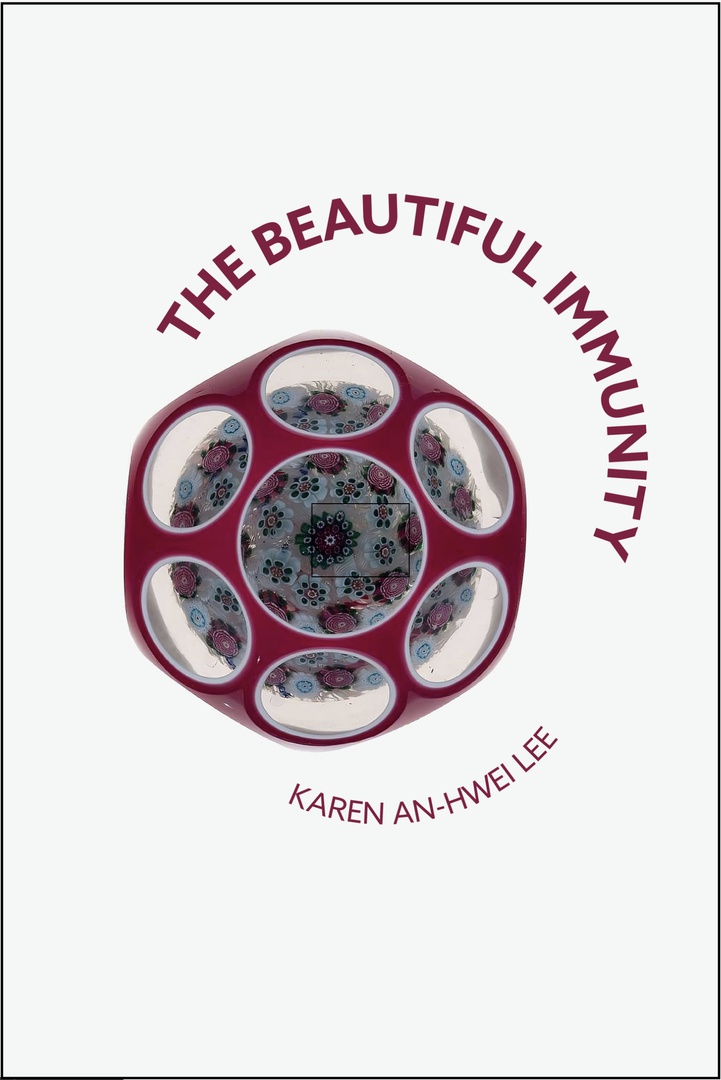
Karen An-hwei Lee,
The Beautiful Immunity,
Tupelo Press, 2024.
ISBN: 978-1961209077. 124pp. $19.95.
Karen An-hwei Lee ponders Creation writ large in her thoughtful poems, addressing so many of them “Dear Millennium.” At once, we get a sense of a personal connection to the cosmos, as she speaks directly to that which is greater than the individual self, but what or who is this Millennium? Think of the concept of Millennialism, the belief in an imminent messianic age, the notion of an earthly kingdom of God. Lee seems to be getting at something like this in these poems. Lee takes a Christian point of view throughout, invoking the Holy Spirit in “On the Flavor of Awe,” “On Reverse Parousia, the Sequel,” “Irenology” and elsewhere, praising Jesus in “Dear Millennium, in Tongues of Angels” and “Dear Millennium, Live” (“flame-treasures of Christ”), expressing a sort of rapture about the God of the Bible everywhere. In “On Hierophany” she tells us, “I invited God into language. Or God existed
before language, while God is also the word.
Remember,
all theophanies are forms of hierophany. However,
the converse is not always true—not all hierophanies
are theophanies—or God visible in the world.
There’s a real sense of the immanence of the godlike around us. The very second “Dear Millennium” poem suggests this – “Dear Millennium, Inside a Hummingbird Is God.” The divine is pervasive, everywhere. (“On a calyx of bougainvillea, a gill of rain on ranunculus, / lamp-colored resin in fire hills of whitebark….”). In addition, an entire section of twenty-two poems – DEAR MILLENNIUM, ON THE BEAUTIFUL IMMUNITY – amplifies this approach.
But it’s the very first “Dear Millennium” poem, “Dear Millennium, Inadequate Witness,” that presents the essential conflict, how in an imperfect world can we foster the good? (“Modes of witness / expose our inadequacy, the human.”) Humans are so fallible. In “On the Flavor of Awe” she spells it out: “God wants us to stop breaking things / and vandalizing creation.”
Karen An-hwei Lee’s essential frame of mind is indicated by
the titles of her poems, especially “prayers” and “meditations.” She is thoughtful and filled with a kind of religious awe. The handful of “prayer” poems include “Prayer for the Lost Bees,” “”Prayer
in the Year of No Rain,” “Prayer at Thirty-Seven Thousand Feet above Sea Level,” and the “meditation” poems include “Meditation on Skin,” “Meditation on Error as Beauty,” “Meditation on
Fruit-Bearing,” “Meditation on Soteruology,” “Meditation on the End of All Things” and others.
Reminiscent of Montaigne’s essays, the poems beginning with the word “on” clue the reader in to Lee’s philosophical mindset. “”On Insect Holes as Fragrant Portals of
Edible Light,” “On Meridians of Love and Distance,” “On Lucid Dreaming,” “On a Lovefeast of Yesterdays,” “On Laughter in a Garden, Post-Catastrophe,” are a sample of the twenty-five poems that start
with “On.” They likewise indicate the reverent posture Lee takes. The fourth of the four parts of The Beautiful Immunity, indeed, is titled ON
MERIDIANS OF LOVE AND DISTANCE.
The recent period of drought in California also fuels Lee’s meditations, specifically. She is not just enthralled by nature in the abstract but in this particular
moment. “Are we in a raging famine, dear millennium?” she asks at the start of “On Levitation in a Season of Famine.” “The four-year drought ruins our agronomy,” she writes - oranges, figs, cotton,
the vineyards. “Prayer in the Year of No Rain” starts:
The year I turned forty coincided with the worst
drought
in California since I moved west, if not for decades.
Over a thousand trees in the oldest arboretum west
of the Mississippi flailed in thirst. Fish died of salinity—
saltwater intrusion in rivers.
Throughout these songs of gratitude and lament, Karen An-hwei Lee seeks healing – personal, social, global – offering a comfort and a sense of possible redemption, despite our repeated failings. As she concludes the poem “Dear Millennium, on Weather Alerts and Doxology”:
Let us praise God for what we
know
only in this realm, the uncertainty of weather,
neither conquered nor contained.
Dear Reader, take comfort and hope from these carefully observed and elegantly argued poems of faith; inoculate yourself against despair. The Beautiful Immunity is medicine for the soul.
Charles Rammelkamp
To order this book click here
Charles Rammelkamp is Prose Editor for BrickHouse Books in Baltimore, where he lives, and edits The Potomac, an online literary journal. http://thepotomacjournal.com. His photographs, poetry and fiction have appeared in many literary journals. His latest book is a collection of poems called Mata Hari: Eye of the Day (Apprentice House, Loyola University), and another poetry collection, American Zeitgeist, is forthcoming from Apprentice House.
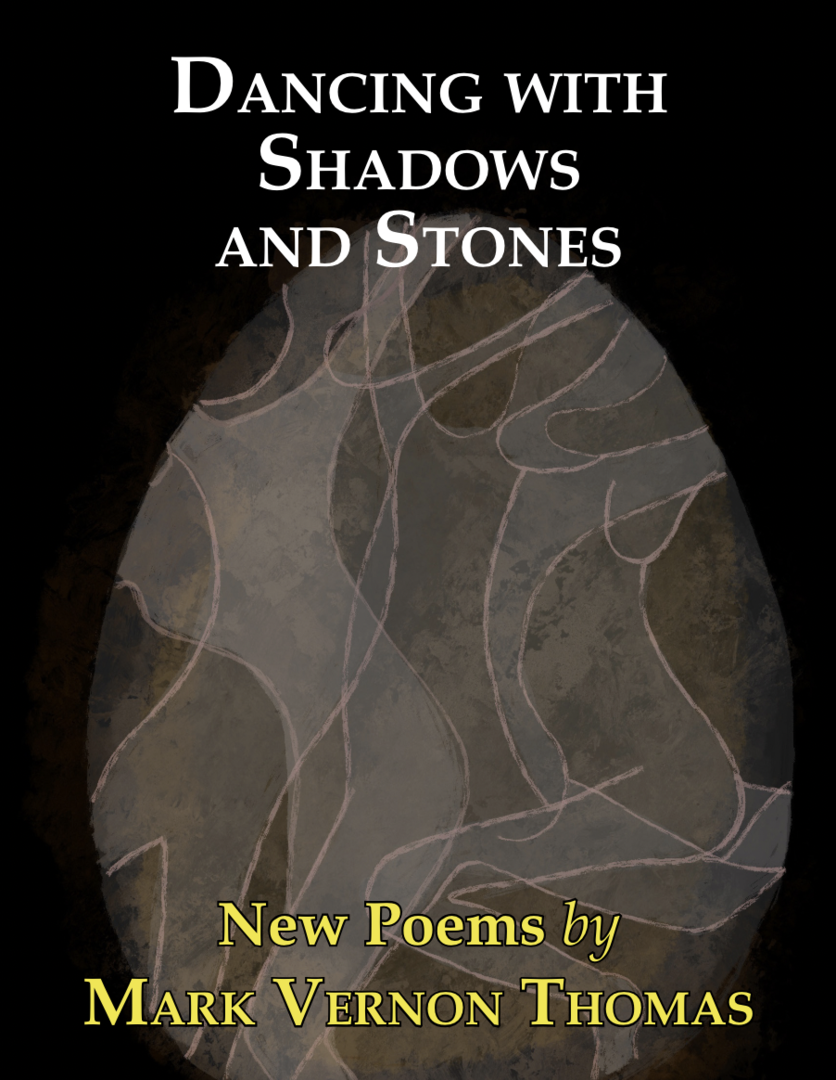
Mark Vernon Thomas,
Dancing with Shadows and Stones,
Drunk Muse Press, 2023.
ISBN: 978-1-8384085-2-7. 61pp. £10.00.
This is Mark Vernon Thomas’ debut collection and it is reasonable to surmise from the biographical information provided by the publisher that he has taken to writing poetry at a fairly late stage in his life. However, he has been fully engaged with other forms of creative expression prior to his becoming a poet, such as a classical musician, a jazz improviser and a singer of Georgian polyphony, and these endeavours have obviously provided him with a rich foundation for his poetry. This is reflected in the quality of the work and its bravura assurance.
Perhaps too in the preceding years some of these poems were slowly forming ready to arise and be shaped, for here is a poet positively incandescent with the urge to write poetry. It is this which powers the energy and invention that characterises his work and makes it so arresting and captivating. Some of the pieces included are extracts from longer works, indicative of a writer teeming with ideas and possibilities of expression. One gets the feeling that this collection does not quite contain such a power house of a poet. If he sometimes over reaches himself we can forgive this and see it as following Browning’s dictum that one’s hand should exceed its grasp.
One should not ignore, however, Thomas’ dedication to the technical craft of poetry and his ability in that respect. He writes with precision and aplomb, as in the following lines from ‘Another sunny April day’, which stand out all the more because they steer clear of the standard ‘poetic’ register: “The sea should be slate grey, but today is / silver, glittering with fractals.”
Generally he favours free verse but his delivery is so on point that the lines are never flat or flaccid. His control is demonstrated in the following sinuous lines from ‘After Rain’:
They tell me
the cloud that is you will
drift, become rain, mist,
snow, molecules in a star –
as all of us will one day drift,
become light rippling on water,
the hum in the wires,
wind singing through grass.
This is a poet who understands that poetry is essentially an aural medium which works as much through word music as how it reads on the page.
Further proving his technical abilities, he tackles fixed forms too. There is a very skilfully handled sonnet, ‘Blue Sonnet’, which plays off the sonnet form against the allure of a blues song. “It’s hard to write a sonnet when you/want to sing the blues.” The closing couplet has the usual end-stopped rhyme hidden in what sounds like the chorus of a blues number:
Ghosts who live on that muddy track, they’ll all
tell you: there’s no way home, there’s no way back.
The wry humour informing this sonnet is to be found throughout the book but it is far from merely comic, on the contrary it demonstrates a sophistication that is informed by a sharp wit. What is on offer here is a poetry of ideas. Indeed there is the seam of an ars poetica running through the collection indicative of a poet who has thought long and hard about the practice of poetry.
Another fixed form he tackles is the sestina. I have to own up to not being a sestina fan. It strikes me as often a Quixotic undertaking, where poets try to prove their technical mettle but often come unstuck. I was pleasantly surprised, therefore, that Thomas has produced a sestina which has coherence as a poem in itself and flows so easily you might not realise at first it was a sestina. In other words, he avoids the pitfalls of producing a poem that is overwrought and stilted. Entitled’ Blue noir’ it choreographs an encounter in a bar between a lonely and depressed bar-fly and a mysterious female figure straight out of a Raymond Chandler or a Dashiell Hammett novel who sashays in unexpectedly: “red dress, hazel eyes, dark / hair tumbling like a river and a wry / smile just for me”. Her words offer solace and insight: “feeling blue / only means you can feel.”
One is struck by the variety of Thomas’ writing. As well as the forms already mentioned, he embraces prose poems too which offer an even freer means of expression than free verse for his effervescent invention. While in ‘The Season’, a four page verse narrative, he allows himself even more latitude. It reads like a fable or a science fiction narrative. I was reminded of the early SF poems of D.M. Thomas. It definitely bears comparison with the latter’s work in terms of quality. ‘The Season’ has a spoof introduction, supposedly a fragment of corrupted text “ found tumbling in deep space of as yet unknown chemical composition…a translation into Old Sogharian, itself barely understood even by scholars today” purporting to be written by Dr Eshira Pownt.
Such playfulness is an engaging feature of his work. It is used to good effect in several opening lines as an irresistible enticement. The following examples give some of the flavour: “I’m wearing my trademark sensitive-poet-skin tonight.”
“Last night a shark swam into my dream and ate it.” “A giraffe walked past my window” It would be wrong to conclude, however, that Thomas is a stand-up poet. He certainly can work a crowd, as they say, but he is also a serious poet of depth as I have already pointed out. The title poem alone confirms this, with its unforced lyricism and elegiac tone:
I am too transitory to read the intentions of shadows.
They dance with such a variety of touch,
spinning through atoms of time and space,
stepping from strobing chaos to
a caress delicate as fine lace.
In Dancing with Shadows and Stones, Thomas makes a dazzling debut that confirms him as a poet to watch.
David Mark Williams
To order this book click here
David Mark Williams writes poetry and short fiction. He has two collections of poetry published: The Odd Sock Exchange (Cinnamon, 2015) and Papaya Fantasia (Hedgehog, 2018).
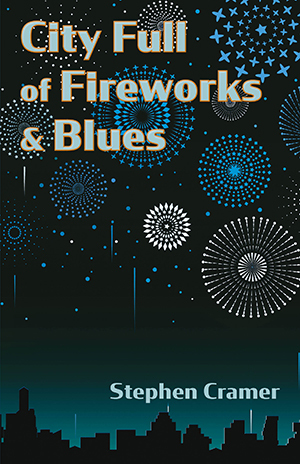
Stephen Cramer,
City Full of Fireworks & Blues,
Shanti Arts Publishing, 2024.
ISBN: 978-1-962082-11-2. 99 pp. $15.95.
According to Britannica, a page-turner is “a book, story, etc., that is difficult to stop reading because it is so interesting.” I have never used “page-turner” in a review of a poetry book nor have I ever seen it used in such a review, but Stephen Cramer’s new collection, his ninth, is indeed just that, 50 poems that demand to be read at a single sitting, in a single breath if you had the lungs to manage it.
The first poem in the book is called “Relief.” Preceding Part I, the customary “invocation to the Muse,” in this case, it’s the poet’s prayer to the atoms of his body:
So today, my prayer
goes like this: please,
manifold tribe
that makes me up,
help me,
while you can,
to relieve my mouth
of this song.
Well, the atoms of Stephen Cramer’s body do not let him down. They answer his prayer resoundingly with the 49 pitch perfect, exquisitely crafted poems that follow. Taken as a whole, the book is a balancing act --- an imbalancing act, I should say -- the search for equilibrium, for the reconciliation of opposites, the longing to unite the physical and the spiritual realms, the deep past and the immediate present, the yin and the yang of human existence. The speaker attempts to create, through sheer force of will, the still point between the extremes that surround us and that inhabit us. “We stumble around/ in circles. We live/ & by living try/ to excel in the art/ of imbalance,” he writes. (“Wings”) The poet tries “to learn that this moment/ is not only now/ but also everything/ that has brought us/ to now, the way/ the mockingbird’s/ unreeled repertoire/ consists of both/ car alarms & the calls/ of extinct birds.” (“The Calls of Extinct Birds”) The world is “both mango & knife edge.” (“Hollow”) The body is a combination “of blood/& curiosity, our heads/ rare collections/ of fantasies & fears.” (“Museums”) Addressing “the only human/ bone that doesn’t touch/ another,” the poet acknowledges that it’s “the way/ our bodies teach us/... how we can survive/suspended between/ bone & belief.” (“The Hyoid”)
Then there is the music, which is everywhere. The words “music,” “song,” and “sing,” occur over and over, more than twenty times by my count, but every poem is music, every poem is a song, every poem sings. There’s Dizzy Gillespie’s trumpet, Charlie Parker’s alto, Hank Mobley’s tenor, but most importantly, there’s the poet’s own voice: “Some days the blues/ shadow me like/a badly dubbed/ film, lines lagging/ just behind the lips.” (“Found in Translation”) “I’ll never be the housefly/ buzzing in the key/ of F, but I can hum/ in harmony,” he proclaims. (Ah, so that’s the tune Dickinson’s fly sang!) And there’s the only poem in the book that employs rhyme, understandably, for it’s a song lyric:
I strum the shower’s steamy air,
my fingers pinching a pick
that isn’t there.
My job pays dirt, & life’s unfair,
so I make chords of my fingers
& shake my hair.
The foggy mirror knows
that I don’t care. I purse my lips
with a screw-the-world stare.
My jaw is a vice
& my eyes are a dare.
& my instrument is made of air. (“Air Guitar”)
The title poem of the book, “City Full of Fireworks & Blues,” is what the poet’s daughter called a painting she was working on. Here’s the poem in all its dark luminescence:
That’s what Isa called
the long sweeps
of orange & purple
that she spent all morning on –
the sky a stipple
& wash of tones, part pulsar,
part jungle gym.
I check back in with her
later, & she’s eclipsed
the whole page with black.
It’s like the painting
has died. To her,
dying is like stepping
into a closet. You can take
a flashlight with you
& step back out
with a grin.
She doesn’t know
the knob comes loose
in your hands.
In the book’s final poem, “The Path,” the poet addresses the road – a metaphor for life -- he and his daughter are walking on: “...you lead/ me on, you take me for a ride,/ you disappear/ altogether, & then/ you find my feet again, oh path.” I prefer to read this not as the last poem but as the first poem of the book yet to come, to see this as the road to the next city full of fireworks and blues. And oh, Stephen, don’t forget to bring Isa again, please.
J.R. Solonche
To order this book click here
Nominated for the National Book Award and twice-nominated for the Pulitzer Prize, J.R. Solonche is the author of thirty-six books of poetry and co-author of another. He lives in the Hudson Valley.
It's not easy getting a book or pamphlet accepted for review these days. So in addition to the regular review section, the One Poem Review feature will allow more poets' to reach a wider audience - one poem featured from a new book/pamphlet along with a cover JPG and a link to the publisher's website. Contact the editor if you have released a book/pamphlet in the last twelve months or expect to have one published. Details here
Reviewed in this issue
 Share
Share Print
Print