
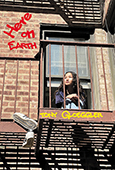
Tony Gloeggler, Here on Earth,
YQ Books, 2026, ISBN: 978-1630451097, 138pp, $21.95.
In the poem, “Kind of Poet,” Tony Gloeggler describes what motivates him to write, how he goes about constructing his poems:
I try to find something to say
about my everyday sights, get
in touch with myself, dig
into mind-haunting thoughts,
help hold my world together,
record, remember, celebrate,
mourn, explore, discover a fuller
understanding, empathy, say
it right and true, make you glad
you read it, if someday you do.
“No sestinas, pantoums, ghazals,” he declares earlier in the poem, and “Never a haiku.” Of course somebody (me) could still categorize, label Gloeggler’s poetry – narrative, confessional – but the point is that Gloeggler’s concerns outweigh the forms. The thoughts will not be caged in rhyme schemes. Which is not to say he doesn’t have a “style”: Tony Gloeggler’s voice is distinctive. The closures are so often stunning but nary a rhymed couplet.
Visually, Tony Gloeggler’s poems are often like a single block of words running down the page, or several pages, sliced into lyrical lines of nuanced meaning, rarely broken into stanzas, except for a kind of pause sometimes, to catch his breath, as he ponders the different situations that have engaged his attention – love, work, family.
Bottom line is, Tony Gloeggler is a mensch. We see him casually caring for other people – his mom as she lies dying (“Again,” “Still Alive,” “Glaucoma,” “Hoping,” “Box of Rain,” “Help Me,” “Minutes,” “Working Class Heroes”); Jesse, the autistic guy to whom, as he writes in “Maintaining World Order”, Gloeggler is “combination step-father, older / brother, death till we part friend” (“Still Alright,” “Autistic Evening Routine,” “June One,” “New House,” “Maintaining World Order,” “Little Things,” “Enough,” “Story Time,” “Here on Earth,” “Behavior Plans,” “Autistic Feast,” “Any Other Way,” “A Place in the World”); the residents in the group home in Brooklyn for developmentally challenged people that he managed for decades – Larry, Robert, Lee, James, and the rest, people who are like characters in a novel the reader comes to care about (“Belonging,” “Minimum Wages,” “Show Don’t Tell,” “Group Home Questionnaire,” “How to Run a Group Home for the Developmentally Disabled While Falling in Love with Suzanne,” “Disability Pride Parade,” “Hoping,” “MRI Set to Music,” “Can Hardly Wait,” “Overwhelming,” “All of Them,” “Confessions,” “Moments”).
In all of these poems we see a caring, compassionate, helpful person going about easing the lives of others as they struggle with their own challenges and obstacles. In “Honestly,” sitting at his mother’s bedside, he patiently engages her in conversation, memories, reflection:
Anything to take her mind
ff her pain, a breath
from boredom.
Spooning a slice of melon into her mouth, he presses her for details about Uncle Dom, Cousin Louie, his father, what she admired about his girlfriends, about her children. “When she gets / to me, she says honesty.”
Indeed, this is the main quality of Gloeggler’s voice, his unflinching candor. Not only in discussing his poetry and the people he cares for, but in his own life – his love relationships, his poetry, neighbors, friends, colleagues, life in general. In “Moments,” a post-retirement poem, while reflecting on the people from the group home he managed, he observes: “For a few
moments, you wish you were still
working, reaching for the alarm,
getting off the E train, hurrying
through the 42nd Street tunnel,
moving like you still mattered,
needed to be somewhere,
to do something good, help
make somebody’s life better.
In several poems, Gloeggler addresses himself this way,
talking directly to “you.” In “Lonely” he confronts himself about his love life; in “Spectrum” he considers his friend with an autistic son, but you get a sense he’s also talking about himself when
he writes:
Your friend is worried his autistic son
will never find love and you’re not sure
he means that long time marriage, kid
kind, or a breathless unexpected fling
that lasts all summer long, or just holding
the hand of his junior high girl, squeezing
a bit tighter at a streetlight…
And in “Confessions” Gloeggler, who writes poems about going
to Saint Ann’s Catholic School as a kid, is his own priest as he recalls a time he may have hit one of the disabled residents of the group home a little too hard. It’s a poem about people who’ve
“gotten away with it” when they have crossed a line. Here, after writing up Jimmy’s injury as if it were a case of him losing his balance and falling, Gloeggler, feeling guilty, confesses to Joan,
another group home manager, what he’s done, even offers his resignation. She listens, asks if it was a one-time thing, absolves him.
She says it’s between you and her, nods and rips
up your resignation letter in tiny pieces. You thank
her.
You thank her right now, again.
Do you believe
in confession, forgiveness? Who deserves it and exactly
for what?
Who can give it to you?
Joan, Jimmy, yourself?
How long can it last?
Which brings us back to Tony Gloeggler’s confessional style.
It’s not the artful prosody of poetic forms, the rhyme and meter of verse ticking across a page, but the instructive revelations of stories drenched in humanity as we confront our own lived
experience, here on earth. He’s not a rosy-eyed optimist, but he’s optimistic nevertheless. As he writes in his elegy to Ted Jonathan, a friend and poet who took his
life:
We should have talked about suicide. Optimistic
me against Ted’s darkness. The idea of control,
dignity, the freeing from hopelessness and constant
suffering, peace at last, finally, versus everybody
dies, why help it out and hurry it along, the finality,
the no going back of it, just tough your way through
like we always do, holding onto the little things
that lift us momentarily and if you get to a point
you’re thinking about it, say something. I’ll Uber
to Jersey, beat you with a stick ball bat, knock
some sense into your cement
hard head, alright?
Charles Rammelkamp
To order this book click here
Charles Rammelkamp is Prose Editor for BrickHouse Books. His latest collection is The Tao According to Calvin Coolidge, Kelsay Books.
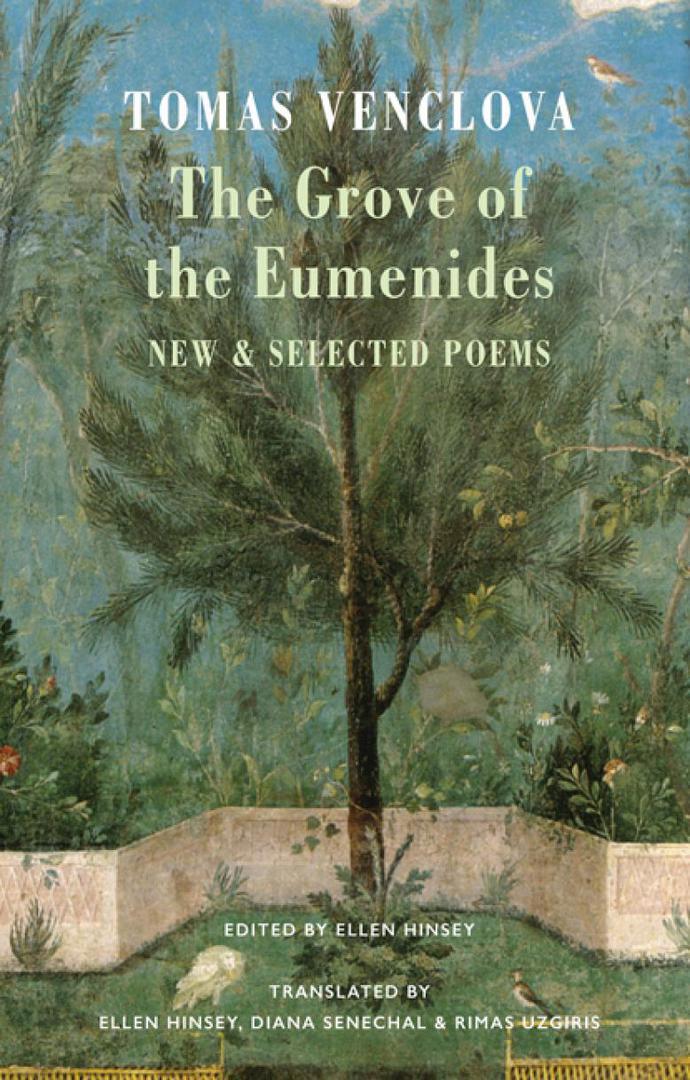
The Grove of the Eumenides by Tomas Venclova, ed. Ellen Hinsey, trans. Ellen Hinsey,
Diana Senechal and Rimas Uzgiris, Bloodaxe,
ISBN 978-1-78037-759-9, 120pp, £14.00.
The late lamented Tony Harrison quotes from Shelley’s A Defence of Poetry as the epigram for one of his poems in the ‘White Queen’ sequence, on ‘the vanity of translation; it were as wise to cast a pansy into a crucible that you might discover the formal principle of its colour and odour, as seek to transfuse from one language into another the creations of a poet.’ That neither deterred Harrison from writing many excellent poems infused (to adapt Shelley’s phrase) with classical predecessors; nor (happily), was it a perspective taken by Dryden, Pope, and Cowper (among many others) each of whom produced well-crafted translations of Homer, with poetic merit in their own right. And – while barred by Soviet censorship from publishing his own verse, Venclova earned a living translating English, French and Russian poetry into Lithuanian. We are indebted to the team of translators, headed up by Ellen Hinsey, for this substantial tome in English.
Bloodaxe are to be commended for venturing down this road again (for my review of their edition of Parch by Menna Elfyn, see the archives of The Lake for January 2026). As I pointed out there, it is difficult to assess the accuracy of a translation without knowledge (and sight of) the original language and its translations. But poetry is not primarily a precise art. ‘Delft’, with its triadic rhyme scheme, must have proved an especial challenge, which is amply met by Hinsey. Each of the poems, in different ways, leaps off the page, though their densely allusive nature often demands re-reading for full impact.
The invocation of canonical greats seems appropriate in tackling this book for review; it commences with a substantial and well-informed introduction by Hinsey, who takes us straight back to the Greek historian Polybius, yoking his theory of anacylosis, more colloquially known as the cyclical nature of change, to Venclova’s endeavours. The shifts between Soviet/Nazi/Stalinist occupation of his motherland, Lithuania, form the backdrop to dramatic poems which detail not just macro-economics and politics, but moments of personal encounters. While ‘Dictator’ focuses on the overthrow in 1989 of Romanian Ceausescu, through modern phenomenon – the ‘strip of sky gleams like glue on an envelope/torn by a censor’, and ‘artificial flowers’ and ‘Rusty, sclerotic pipes’, ‘Azovstal’ brings us right up to date. This poem opens with a paradigmatic invocation: ‘Hail to you, forgotten Goddess of History!’ but addresses the siege of Mariupol, in one of 2022’s worst moments of the war in Ukraine.
Of the four untitled sections, the fourth contains the most tender, intimate subjects, providing contrast to the elegiac and often bleak themes of other poems. ‘Hurricane’ passes by an opportunity for lamenting climate change in favour of observing the children ‘petting the dog,/reading Spiderman to each other, content that school is out.’ ‘To My Daughter’ commemorates two separations, wryly noting ‘rupture is the only fact of life.’
The titular poem, channelling Sophocles’ release of the Furies at the burial place of Oedipus, captures with painful acuity the recurring nature of depravity and ecological disaster. ‘The gods have changed’, and ‘Some homeless dogs/still snore where acacias shade syringes,’ while ‘Cement/now covers sacred slopes.’ It seems we have learned nothing and perhaps deserve that ‘The Lord Almighty plays with us while we/grow blind’ in the now economically deprived suburb of Athens. Is there hope in ‘The Moss of Ammassalik’, which honours the healing power and perseverance of ‘the world’s peacemaker – twisted/Into the gap between gneiss and mist’?
The term ‘magisterial’ seems apt for this achievement, as its author approaches his tenth decade. If only its insightful commentaries on the state of the world were not necessary!
Hannah Stone
To order this book click here
Hannah Stone is the author of Lodestone (Stairwell Books, 2016), Missing Miles (Indigo Dreams Publishing, 2017), Swn y Morloi (Maytree Press, 2019) and several collaborations, including Fit to Bust with Pamela Scobie (Runcible Spoon, 2020). She convenes the poets/composers forum for Leeds Leider, curates Nowt but Verse for Leeds Library, is poet theologian in Virtual Residence for Leeds Church Institute and editor of the literary journal Dream Catcher. Contact her on hannahstone14@hotmail.com for readings, workshops or book purchases.
It's not easy getting a book or pamphlet accepted for review these days. So in addition to the regular review section, the One Poem Review feature will allow more poets' to reach a wider audience - one poem featured from a new book/pamphlet along with a cover JPG and a link to the publisher's website. Contact the editor if you have released a book/pamphlet in the last twelve months or expect to have one published. Details here
Reviewed in this issue

 Share
Share Print
Print