
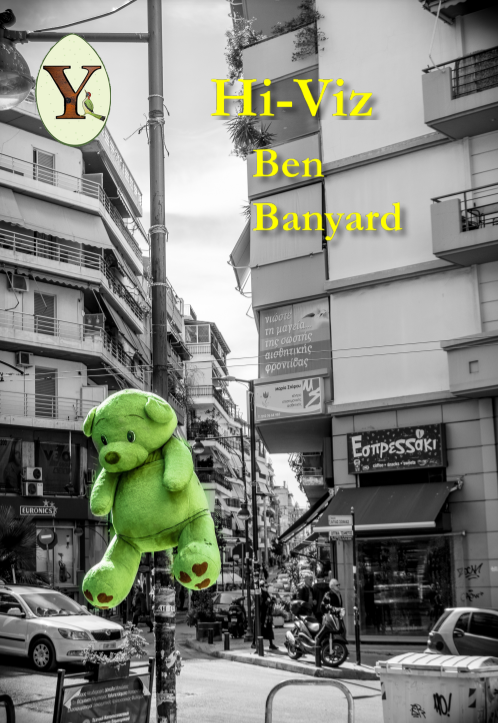
Ben Banyard, Hi-Viz
Slow: Learner
Check your mirrors – rear and both wings.
Push the stalk up to hear that homely tick-tock.
Set the gas – a gentle see-saw balance of pedals.
Release the handbrake and turn the wheel,
look, look, look all around.
And holy shit the car rolls heavily under your touch,
gulps greedily at the asphalt, a trundling monster.
It’ll take a lot more moving off (uphill sometimes),
reversing around corners and parking without clipping the kerb
before you’re allowed to do this without your co-pilot
(a sage owl, feet poised on the dual controls,
with whom you row and get red-faced in confusion).
But then one day, to the strains of Sweet Caroline
someone will finally say, with little fanfare,
Well that’s the end of your test;
I’m pleased to say you’ve passed.
You’ll find you can drive to the seaside,
reverse into cars at the supermarket,
notice that even with a satnav you still get lost
and crawl along in terror when you bring
two babies home from hospital as though
the boot is full of a thousand eggs.
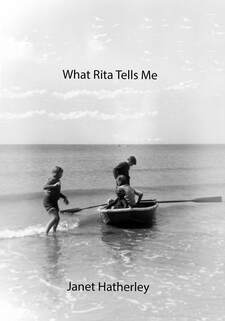
Janet Hatherley, What Rita Tells Me
Trotline
You take a line, about twenty feet, unwind—
tie each end to a piece of pig iron.
At low tide, bury the ends in the sand.
You bait the hooks before the tide turns
and make sure you’re back at the next low tide.
You’ll get bass—be careful of the spines.
Often, with the changing tides, Mum had
to slip out of bed, not waking Dad—set off
with an anorak over pyjamas, to stride
through gusts of wind to crashing seas, white froth,
the deafening noise, with a bike lamp’s feeble light—
imagining a sea serpent lifting her aloft.
This way she fed us, until we grew quite
tired of bass, so she sold it to the fishmonger.
Her biggest fish, after one wild night
gained her a photo in the local paper—
a twelve and three quarter pound cod,
pride of place in the Chichester Observer.
In winter sun, Fred, our cat, followed Mum, trod
warily over seaweed, paddled in rock pools.
She looked for whelks—where are they, the little sods!
He sniffed the air as she found one, its smell rose
with the knife, a quarter fixed on a single hook.
Whelks stay on better than limpets, as it goes.
One rainy night Mum looked up, what a shock!
All the whelks so hard to find earlier—
on the breakwater, glistening in the black.
On the sea wall, most of East Drive’s neighbours
had put up fencing. It went along the bay.
No one could walk along, cross the barbed wire.
Coming home that night Mum lost her way.
She walked around in circles, the tide had turned.
Only one place to climb up, to be okay.
Who’d know she was there, or be concerned?
The sea was coming in so fast and rough—
no one awake and waiting her return.
It's not easy getting a book or pamphlet accepted for review these days. So in addition to the regular review section, the One Poem Review feature will allow more poets' to reach a wider audience - one poem featured from a new book/pamphlet along with a cover JPG and a link to the publisher's website. Contact the editor if you have released a book/pamphlet in the last twelve months or expect to have one published. Details here
Reviewed in this issue

 Share
Share Print
Print